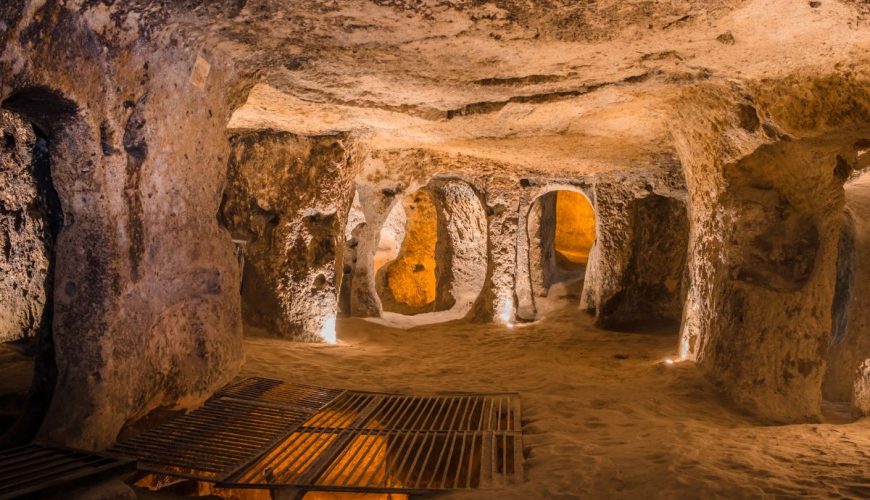
Cappadocia's underground cities are multi-level settlements carved deep into the soft volcanic rock of central Turkey, where whole communities could hide with their animals and food in times of danger. The most famous are Derinkuyu, the deepest open to visitors, and Kaymaklı, the widest. Smaller sites such as Özkonak and Mazı are quieter and just as fascinating. Dozens of underground settlements are known across the region, but only a handful are open to the public.
Going underground is one of the most memorable experiences in Cappadocia. This guide explains who built the cities and why, what you will see inside, how the ventilation and stone doors worked, which city to choose, and how to visit them on a self-drive day from Göreme.
Why were the underground cities of Cappadocia built?
The underground cities were built as places of refuge. Cappadocia's soft volcanic tuff is easy to carve with simple tools, yet strong enough to support tunnels and rooms. For centuries, people living on the plateau dug cellars and storerooms beneath their houses, and over time these were extended downwards and joined into networks of passages and chambers on several levels.
When raiders or armies approached, villagers could retreat underground, seal the entrances from inside and wait in safety. The cities were not meant to be lived in permanently, but they were equipped for stays of days or weeks, with stables, kitchens, storerooms, wells and chapels.
Who built them? A short history
No single date or builder can be given for the underground cities, because they grew over many centuries.
- Early beginnings. The first chambers may have been cut as early as the Phrygian period, around the 8th to 7th centuries BC, according to the Turkish culture authorities and many historians. The evidence for this early phase is limited.
- Roman and early Christian periods. Christian communities in Cappadocia expanded the underground spaces, adding chapels and more extensive networks.
- Byzantine era. The cities reached their greatest extent during the Byzantine period, especially during the long Arab-Byzantine wars of roughly the 8th to 10th centuries, when raids across Anatolia were frequent. This is when most of what you see today took shape.
- Later use. Local communities continued to use the tunnels as shelters in later centuries. The underground spaces of Kaymaklı are reported to have been in use until the early 20th century, and the houses of the modern villages still use parts of the tunnels as cellars and stables today.
The best-known modern rediscovery is Derinkuyu's. In 1963, a resident renovating his house broke through a wall and found a passage behind it, which led to the vast complex now open to visitors.
Derinkuyu Underground City
Derinkuyu is the deepest underground city open to visitors in Cappadocia, reported to reach a depth of about 85 metres. The name means "deep well" in Turkish. Only part of the complex is open, but even that takes you down through several levels via steep, narrow passages.
Inside you will find:
- Stables near the surface, where animals were kept close to the entrance.
- Kitchens with walls blackened by centuries of smoke.
- Wine and oil presses carved directly into the rock.
- Storerooms, dormitories and communal halls.
- A chapel or church on the lower levels, reached by a long stairway.
- Wells and ventilation shafts that run from the surface to the deepest floors.
Derinkuyu is often said to have been able to shelter up to 20,000 people together with their livestock, although such figures are estimates. It is also reported to have been connected to Kaymaklı by a tunnel of several kilometres; that tunnel is not open to visitors.
Derinkuyu suits visitors who want the full experience of going deep underground. Be prepared for low ceilings, steep steps and some crouching.
Kaymaklı Underground City
Kaymaklı is the widest of Cappadocia's underground cities open to visitors, about 10 km north of Derinkuyu on the same road. It is reported to have eight levels, of which four are open, and it has been open to visitors since 1964.
The tunnels at Kaymaklı are lower, narrower and steeper than at Derinkuyu, but the city does not go as deep. You move through a maze of small rooms and short passages: a stable on the first level, a church with a baptismal font on the second, kitchens and storage on the third, and many storerooms for earthenware jars on the fourth. Look out for a stone block pierced with dozens of holes, thought to have been used in metalworking.
The modern village of Kaymaklı is built directly above the underground city, and many of its houses still use tunnels below them as cellars and stores.
Kaymaklı is often the better choice for visitors who dislike great depth, since you stay closer to the surface, though the passages can be tight.
Özkonak Underground City
Özkonak is a quieter underground city north of Avanos, rediscovered in 1972 by a local villager who noticed water from his fields disappearing into the ground. It is reported to have around ten levels, of which four are open to visitors.
Özkonak is known for its defensive details. Holes in the ceilings above some passages are thought to have been used to pour hot oil or throw objects onto attackers. Narrow channels a few centimetres wide connect the levels, believed to have served for ventilation and for communication between floors. Rolling stone doors still stand beside several passageways.
Because it lies away from the main day-tour circuit, Özkonak usually sees far fewer visitors than Derinkuyu and Kaymaklı. It is a good choice if you are based in Avanos or want to combine it with a drive to the north of the region.
Mazı Underground City
Mazı is a small, rarely crowded underground city in the village of the same name, about 18 km south of Ürgüp and around 10 km east of Kaymaklı. The village's ancient name was Mataza.
The complex is mostly made up of stables, which suggests the community kept many animals. You can also see a wine cellar with holes in the ceiling through which grapes were dropped from above, and a church reached by a short passage that could be sealed with a millstone door. Mazı was closed for some years for safety reasons and reopened to visitors after restoration work in 2015.
Only part of the site can be visited, and its rough, uneven passages give a real sense of exploration. Mazı is a good option if you want to see an underground city in near silence.
How did the underground cities work?
Ventilation
The underground cities were ventilated by vertical shafts cut from the surface down through all the levels. At Derinkuyu, a large central shaft is linked to many smaller ones, and the openings were arranged so that fresh air circulated even to the lowest floors. Some deep shafts also served as wells, giving access to groundwater without the need to go outside.
Stone doors
Each level could be sealed with large round stone doors, shaped like millstones and set into grooves in the passage walls. They were rolled across the entrance from the inside, so they could only be opened from the inside. With each floor sealed separately, attackers who got into the upper levels could still be kept out of the lower ones.
Food, water and light
Storerooms, wells, kitchens and wine presses meant people could stay underground for long periods. Small niches in the walls held oil lamps. The rock keeps the temperature cool and steady throughout the year, which also made the cities ideal places to store food, a use that continues in modern Cappadocia, where caves are still used to store potatoes, lemons and other produce.
Tips for visiting the underground cities
- Think about claustrophobia. Passages can be narrow and low, and you may need to stoop or crouch for stretches. If you are claustrophobic, start with Kaymaklı or the upper levels and turn back whenever you want.
- Watch your head and back. Low ceilings are the most common complaint. People with back or knee problems should take extra care on steep steps.
- Wear good shoes. Floors are uneven and steps are worn smooth. Trainers or walking shoes are best.
- Bring a light layer. It stays cool underground year-round, even when it is hot outside.
- Go early or late. Midday is busiest, when tour groups move through the narrow tunnels in long lines. The first hour after opening and the late afternoon are much calmer.
- Follow the arrows. Routes are marked and some areas are closed for safety. Stay on the open path.
- Consider a guide. Signs inside are limited. A local guide brings the rooms to life and explains what each space was used for.
- Allow time. Plan about an hour for each of the larger sites.
Which underground city should you visit?
If you only have time for one, choose Derinkuyu for depth and drama, or Kaymaklı if you prefer to stay nearer the surface. If you want to avoid crowds, choose Özkonak or Mazı. Many travellers combine Derinkuyu and Kaymaklı in one half-day, since they are only about 15 minutes apart on the same road.
Visiting the underground cities by car from Göreme
With a car, the underground cities fit easily into a day in Cappadocia. Approximate drive times from Göreme:
- Kaymaklı: about 25 minutes south, via Nevşehir.
- Derinkuyu: about 35 to 40 minutes south, around 10 km beyond Kaymaklı.
- Özkonak: about 30 minutes north, via Avanos.
- Mazı: about 30 to 40 minutes, via Ürgüp or Kaymaklı.
A south loop: leave Göreme early, visit Kaymaklı at opening time, continue to Derinkuyu, then drive west towards the Ihlara Valley for an afternoon walk among rock-cut churches along the river. This makes a full and varied day.
A north loop: visit Özkonak in the morning, then return via Avanos, known for its pottery workshops on the Kızılırmak river, and on to the valleys and viewpoints around Göreme.
The roads around Cappadocia are generally good and well signposted, and parking is available at all the main sites. For the rest of the region, read our guide on what to do in Cappadocia and our main Cappadocia page. If you are driving from Istanbul, our post on Istanbul to Cappadocia by car covers the route, and driving in Turkey explains the practicalities.
The underground cities on our routes
The underground cities appear on our sample routes through central Anatolia, including Istanbul, Cappadocia and Antalya via Ankara and the longer Grand Turkey for Summer, which continues to the coast, Pamukkale and Ephesus. For more ideas on how to put a route together, see our Turkey road trip itinerary guide.
Plan it as a self-drive trip
With your own car, you can reach the underground cities at opening time before the tour groups, add a quieter site like Mazı or Özkonak, and still have the afternoon for the Ihlara Valley or the valleys around Göreme.
Tell us when you want to travel and what interests you, and we will design a personal Cappadocia itinerary with hand-picked cave hotels, a rental car and support throughout your trip. If you would like a local guide for the underground cities, we can arrange that too.