Ephesus is the most complete classical city in the eastern Mediterranean and the single most visited ancient site in Turkey. Walking down its marble streets, past fountains, temples and shops, toward the two-storey facade of the Library of Celsus, gives you a rare sense of what a great Roman city felt like.
This guide focuses on what you need to plan a good visit: the history in short, the monuments not to miss, the Terrace Houses, the Temple of Artemis and the House of the Virgin Mary, how the two entrances work, the best time of day, how long to stay, and how Ephesus fits into a road trip with Selçuk, Şirince and Pamukkale.
Where is Ephesus?
Ephesus (Turkish: Efes) lies in western Turkey, in Izmir province, just outside the town of Selçuk, about 80 km south of Izmir and roughly 20 km inland from the resort town of Kuşadası. In antiquity it was a port city; the harbour silted up over the centuries, and the sea is now several kilometres away.
By car, Ephesus is about 1 hour from Izmir and its airport, around 30 minutes from Kuşadası, and about 3 hours from Pamukkale.
A short history of Ephesus
Ephesus was founded as an Ionian Greek city, according to tradition by Androklos, a prince from Athens, near an older Anatolian settlement and the sanctuary of a mother goddess later worshipped as Artemis. The city moved several times as the coastline shifted. Around 300 BC, Lysimachus, one of Alexander the Great's successors, refounded it in the valley where most of the ruins you see today stand.
Under Rome, Ephesus became the leading city of the province of Asia and one of the largest cities of the empire, a busy port, trading hub and centre of the cult of Artemis. Most of its monuments date from the 1st and 2nd centuries AD.
Ephesus also played a key role in early Christianity. St Paul lived and preached here, and the Book of Acts describes a riot in the theatre led by silversmiths who sold images of Artemis. Tradition holds that St John spent his later years in the area, and in AD 431 the Council of Ephesus met here. As the harbour silted and earthquakes struck, the city gradually shrank, and life moved to the nearby hill of Ayasuluk, today's Selçuk.
Excavations started in the 19th century and continue today, led by the Austrian Archaeological Institute. Ephesus was inscribed on the UNESCO World Heritage List in 2015, together with the Temple of Artemis, the Ayasuluk hill and the House of the Virgin Mary.
What to see inside the Ephesus ruins
The ancient city is laid out along a main route that runs gently downhill from the upper (south) entrance to the lower (north) entrance. Here are the highlights in that order.
State Agora and the Odeon
Near the upper entrance, the State Agora was the civic heart of the city. Beside it stands the Odeon, a small, well-preserved theatre used for council meetings and concerts, seating about 1,500 people.
Curetes Street
The main street, paved in marble, slopes down toward the library. Along it you pass the Gate of Hercules, the Fountain of Trajan, public latrines and statues of prominent citizens. This is the most atmospheric part of Ephesus.
Temple of Hadrian
A small but exquisite temple on Curetes Street, dedicated in the 2nd century AD to the emperor Hadrian. Look for the carved arch and the reliefs inside its porch, among the best decorative carving at the site.
Terrace Houses
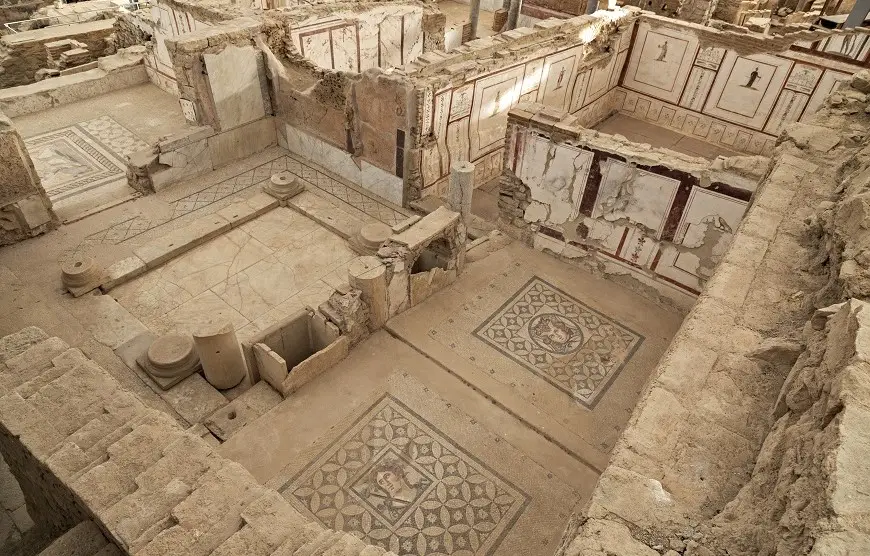
Opposite the Temple of Hadrian, a large modern roof protects the Terrace Houses (Yamaç Evler), the homes of wealthy Ephesians built on the slope. Inside, glass walkways lead over rooms with wall paintings, mosaic floors, marble panelling and courtyards, many still under active restoration.
The Terrace Houses are visited separately from the main route, with their own entry inside the site. Many visitors skip them to save time; we think that is a mistake. They show the private side of Roman life that the public monuments cannot. Allow about 45 minutes to an hour.
Library of Celsus
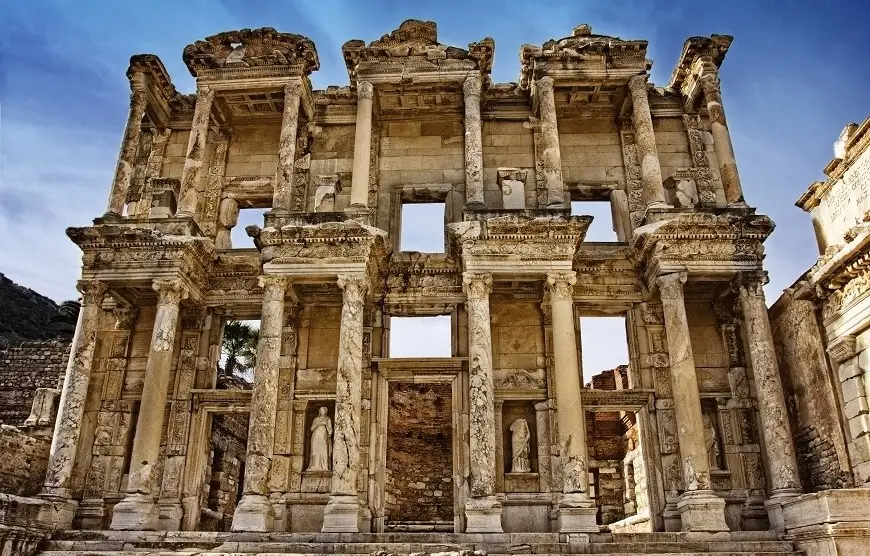
The Library of Celsus is the icon of Ephesus. It was built in the early 2nd century AD by Tiberius Julius Aquila in honour of his father, Tiberius Julius Celsus Polemaeanus, a former governor of the province, who was buried in a tomb beneath the building. The library once held thousands of scrolls. Its richly decorated two-storey facade, with statues personifying Wisdom, Knowledge, Intelligence and Virtue (copies; the originals are in Vienna), was re-erected by archaeologists in the 1970s.
Next to it, the Gate of Mazaeus and Mithridates leads into the Commercial (Lower) Agora, the city's main market square.
Marble Street and the Great Theatre
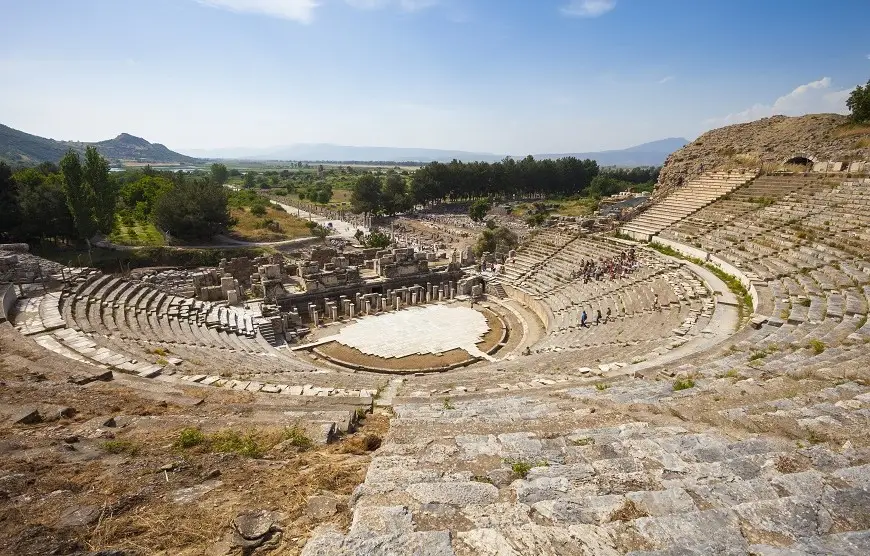
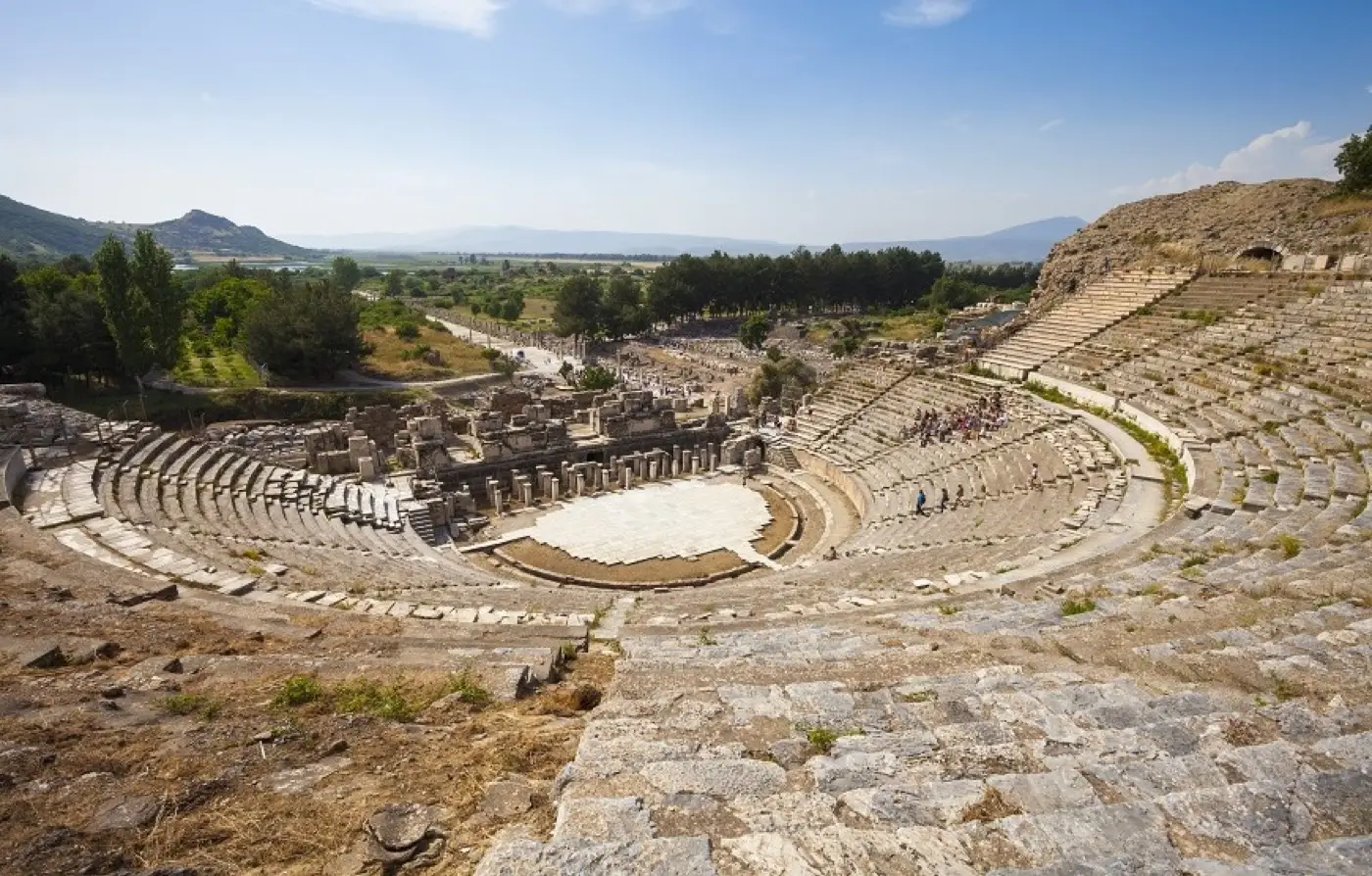
From the library, Marble Street runs north to the Great Theatre, built into the slope of Mount Panayır. It is one of the largest theatres of the ancient world, with seating for roughly 24,000–25,000 spectators. This is where, according to Acts, the silversmiths' riot against Paul took place. Climb a few rows for a view down the Harbour Street.
Harbour Street (Arcadian Way)
A wide colonnaded avenue that once led from the theatre to the harbour. It was lit at night in late antiquity, a rare luxury. The sea is long gone, but the scale of the street says a lot about the city's wealth.
Beyond the ruins: Selçuk and the Ephesus area
Some of the most important sites connected with Ephesus lie outside the main ancient city, in and around Selçuk.
Temple of Artemis (Artemision)
The Temple of Artemis was one of the Seven Wonders of the Ancient World. It was burned in 356 BC by a man named Herostratus who sought fame, rebuilt on an even grander scale, and later destroyed. Today the site, in a low field on the edge of Selçuk, has a single re-erected column, often with a stork's nest on top. It takes only 15 minutes, but standing there with the Basilica of St John and the Isa Bey Mosque in view is a striking lesson in layers of history.
Basilica of St John and Ayasuluk Hill
On Ayasuluk hill above Selçuk, the emperor Justinian built a huge basilica in the 6th century over the traditional tomb of St John the Apostle. Its partly restored columns and arches stand below the Ayasuluk fortress. Nearby is the 14th-century Isa Bey Mosque, a fine early Anatolian Turkish building.
Ephesus Museum
The Ephesus Archaeological Museum in Selçuk displays finds from the site, including the famous marble statues of Artemis of Ephesus. It is compact and worth an hour, especially if you visit Ephesus first.
House of the Virgin Mary
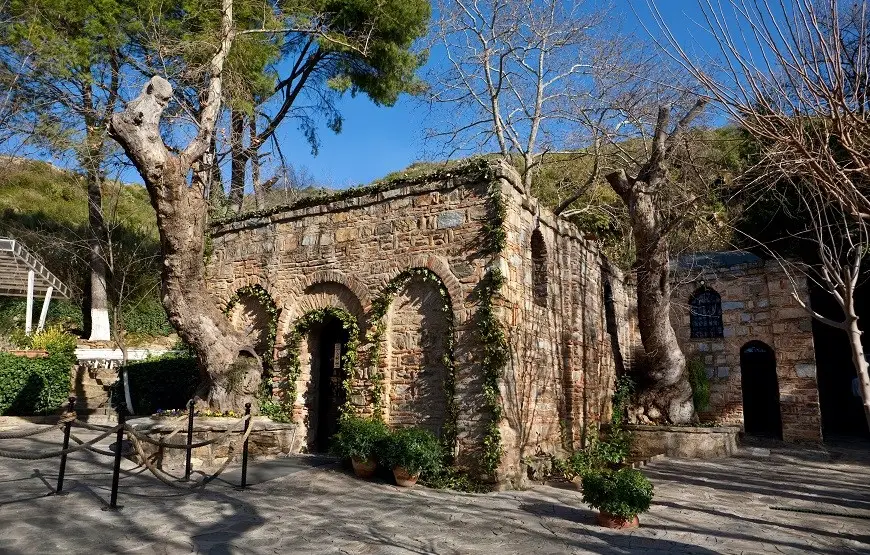
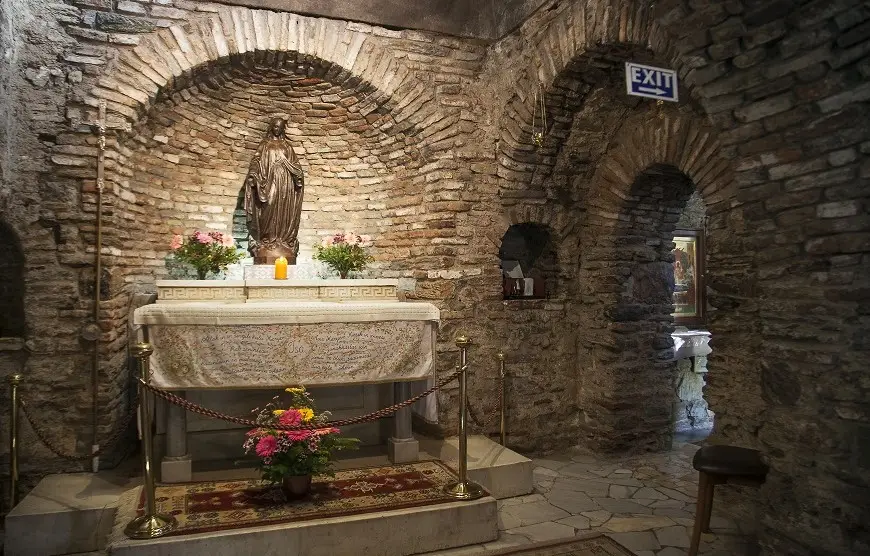
On the wooded slopes of Mount Koressos (Bülbüldağı), about 8 km from the ruins by road, stands a small stone chapel venerated as the House of the Virgin Mary (Meryem Ana Evi). According to tradition, Mary spent her last years near Ephesus with St John. The site was identified in the 19th century and has been visited by several popes. It is a place of pilgrimage for both Christians and Muslims, who honour Mary as well. The visit is short and quiet; dress modestly.
Şirince
About 8 km east of Selçuk, up a winding road through olive groves, Şirince is a hillside village of restored stone houses, known for its fruit wines, olive oil and village breakfasts. It is a lovely place for lunch or an overnight stay after Ephesus. It gets busy at midday in high season; late afternoon is quieter.
Practical tips for visiting Ephesus
The two entrances
Ephesus has two entrances, the upper (south, or Magnesian) gate and the lower (north, or Harbour) gate, both with car parks. The route between them is about 3 km.
- Starting from the upper gate means you walk downhill the whole way, with the Library of Celsus and the theatre near the end. This is the most popular way to see the site.
- If you arrive by car, you will need to return to your vehicle at the end. The easiest options are to park at the lower gate and take a taxi to the upper gate to start, or simply walk back uphill through the site, which is pleasant early or late in the day.
Best time of day
Go early, ideally right when the site opens. Ephesus fills up from mid-morning, especially when cruise ships are docked in Kuşadası and tour buses arrive. The first hour is cooler, quieter and has softer light for photographs of the library. Late afternoon is the second-best option.
How long to spend at Ephesus
- Main ancient city: 2.5 to 3 hours.
- Plus the Terrace Houses: add 45 minutes to 1 hour.
- Plus Selçuk sites (Temple of Artemis, St John, museum) and the House of the Virgin Mary: a full day.
- Ideal: one night in Selçuk or Şirince, so you can enter early the next morning.
What to bring
There is very little shade, and the marble reflects heat. Bring a hat, sunscreen and water, and wear comfortable shoes with good grip; the ancient paving is polished and can be slippery. In summer, avoid the midday hours entirely.
How to drive to Ephesus
For road rules and tips, see our guide to driving in Turkey.
- From Izmir or Izmir airport: about 1 hour south on the motorway toward Aydın, exiting for Selçuk.
- From Pergamon / Bergama: about 2.5 hours, passing Izmir.
- From Istanbul: about 6–7 hours via the Osmangazi Bridge and the Istanbul–Izmir motorway, though most travelers break the journey or come down the Aegean coast via Troy and Pergamon. See our Istanbul to Izmir by car guide.
- From Ephesus to Pamukkale: about 3 hours east, with an easy detour to Aphrodisias.
Plan it as a self-drive trip
Ephesus is the centrepiece of most western Turkey road trips. A classic sequence is Istanbul, Gallipoli and Troy, Pergamon, then Ephesus with a night in Selçuk or Şirince, followed by Aphrodisias and Pamukkale. Our Istanbul–Ephesus–Pamukkale route is built around exactly this, while Istanbul to Izmir is a shorter version and Istanbul to Fethiye and Grand Turkey for Summer continue to the Mediterranean and beyond.
Road Trip Turkey designs every trip for one traveler: you. We plan the route and the timing (so you reach Ephesus early), book the hotels and rental car, and support you 24/7 on the road. Tell us your dates and interests and we will send a personal itinerary. For ideas on pacing, see our Turkey road trip itinerary and self-drive Turkey guide.