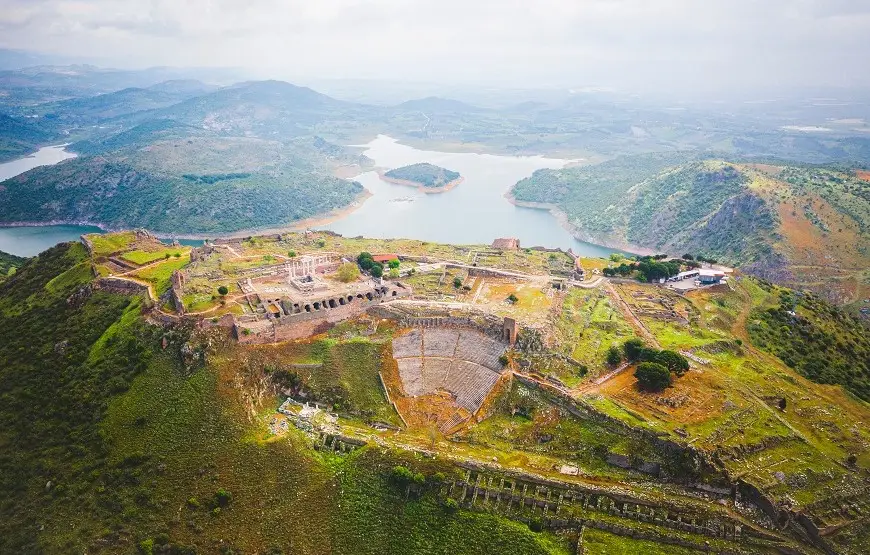
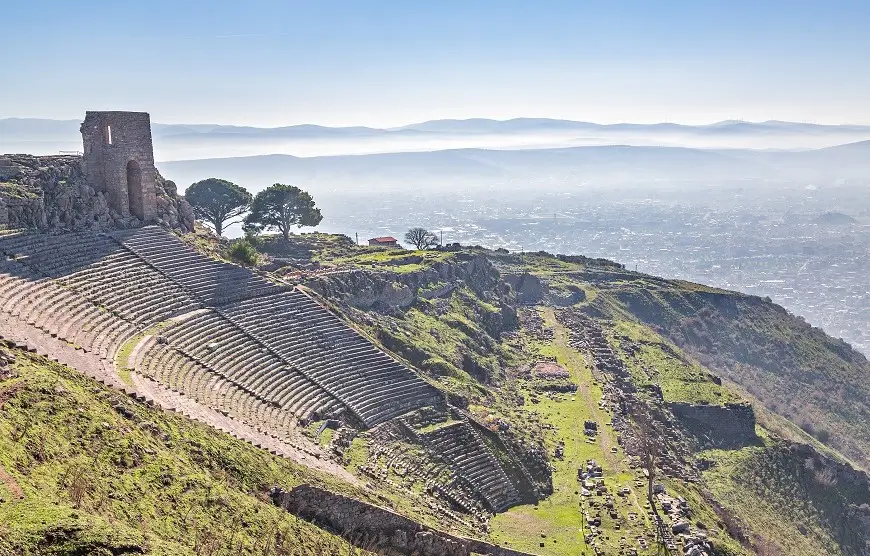
High above the modern town of Bergama, on a steep ridge in western Turkey, stand the ruins of Pergamon, one of the great royal cities of the ancient Greek world. Its kings filled the summit with palaces, temples, a famous library and a theatre that seems to pour down the hillside. Below, on the plain, the Asklepion was one of the most renowned healing centres of antiquity.
Pergamon is less crowded than Ephesus and, for many travelers, even more dramatic. This guide covers what to see at the Acropolis, the Asklepion and the Red Basilica, the story of the Altar of Zeus now in Berlin, practical tips such as the cable car, and how to combine Pergamon with Troy, Ayvalık and Izmir on a road trip.
Where is Pergamon?
Pergamon (also written Pergamum; Turkish Bergama) is in the Aegean region of western Turkey, in Izmir province, about 100 km north of the city of Izmir and roughly 25 km inland from the coast. The ancient city occupies a high, steep hill directly above today's town of Bergama, with the Asklepion and the Red Basilica in and around the town below.
From Izmir it is about 1.5 hours by car. From Troy or Çanakkale it is about 3 hours to the south, which makes it a natural stop on the way down the Aegean coast.
A short history of Pergamon
Pergamon was a modest hilltop fortress until the early 3rd century BC. After the death of Alexander the Great, the general Lysimachus left a large treasure here in the care of an officer named Philetaerus. Philetaerus and his successors used it to build an independent state, the Attalid dynasty, named after Attalus I.
Under kings such as Attalus I and especially Eumenes II (197–159 BC), Pergamon became one of the leading powers and cultural centres of the Hellenistic world. The Attalids allied with Rome, defeated invading Galatian tribes and celebrated those victories with monumental art.
In 133 BC the last king, Attalus III, died without an heir and bequeathed his kingdom to Rome. Pergamon became part of the Roman province of Asia and flourished again under the emperors, when the Asklepion gained its greatest fame and the lower city spread across the plain. In early Christianity, Pergamon was one of the Seven Churches of Asia addressed in the Book of Revelation.
German archaeologists began systematic excavations in the 1870s, led by the engineer Carl Humann, and the German Archaeological Institute still works at the site.
UNESCO World Heritage status
Pergamon was inscribed on the UNESCO World Heritage List in 2014 as "Pergamon and its Multi-Layered Cultural Landscape". The listing covers not only the Acropolis but also the Asklepion, the Red Basilica, ancient burial mounds and the historic Ottoman town of Bergama, showing how the city evolved from Hellenistic capital to Roman, Byzantine and Ottoman town.
The Acropolis of Pergamon
The Acropolis is the highlight of any visit. It sits on the summit of a hill about 330 metres above sea level, towering over the town, and is laid out in terraces that follow the slope.
Getting up: the cable car or the road
A cable car (teleferik) runs from a lower station on the edge of Bergama up to the Acropolis. It saves a long, steep climb and gives superb views on the way. There is also a road up to a car park near the top entrance, so drivers can choose. Check on the day which option is running; many visitors enjoy taking the cable car regardless.
What to see on the Acropolis
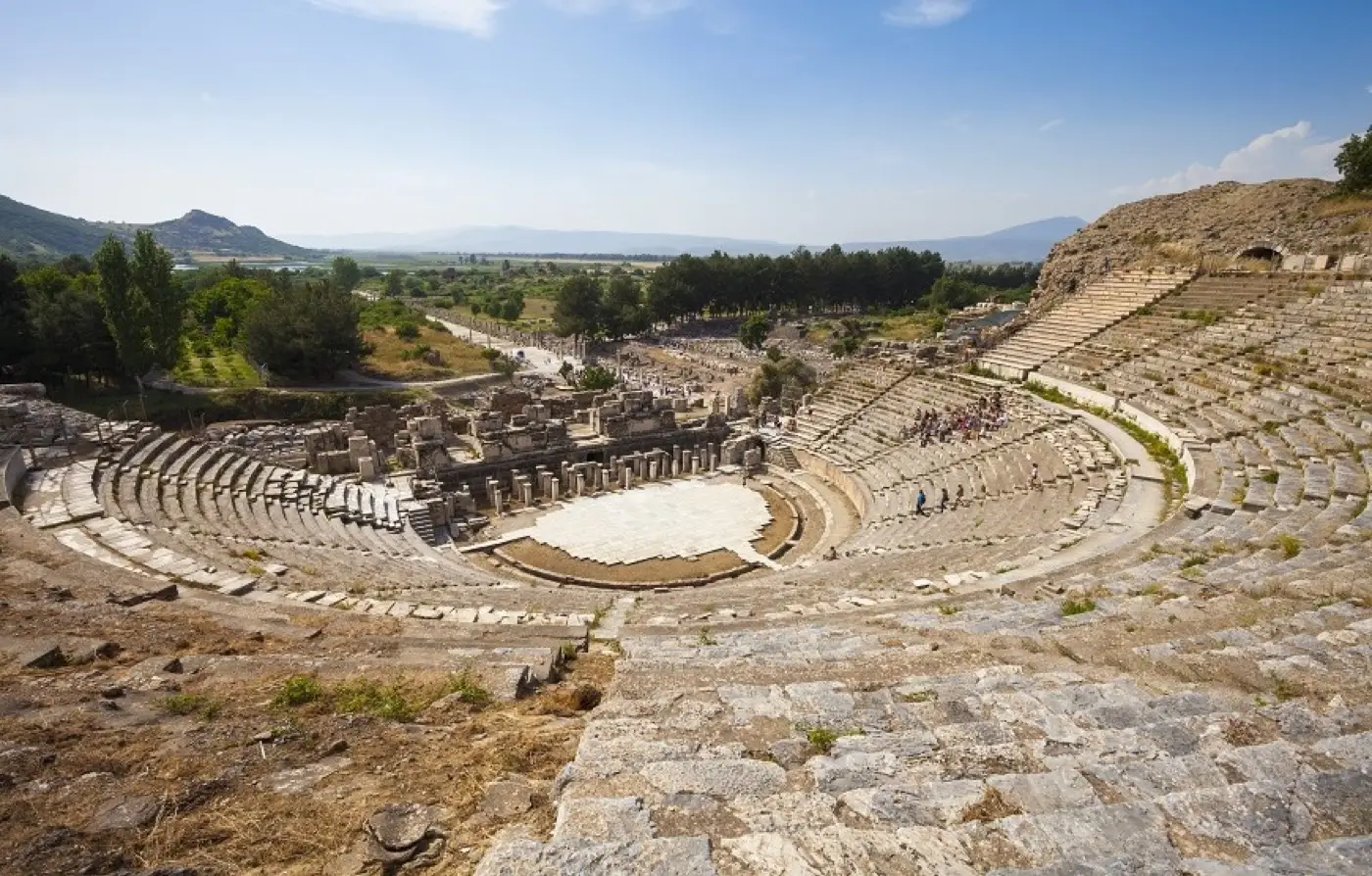
- The Theatre. Pergamon's theatre is cut into the steep western slope and is often described as the steepest theatre of the ancient world. Around 80 rows of seats drop sharply toward a narrow terrace, seating roughly 10,000 spectators. Because the hillside left no room to build wide, the architects built it tall instead. Sitting in the top rows and looking down over the plain is unforgettable, but watch your step.
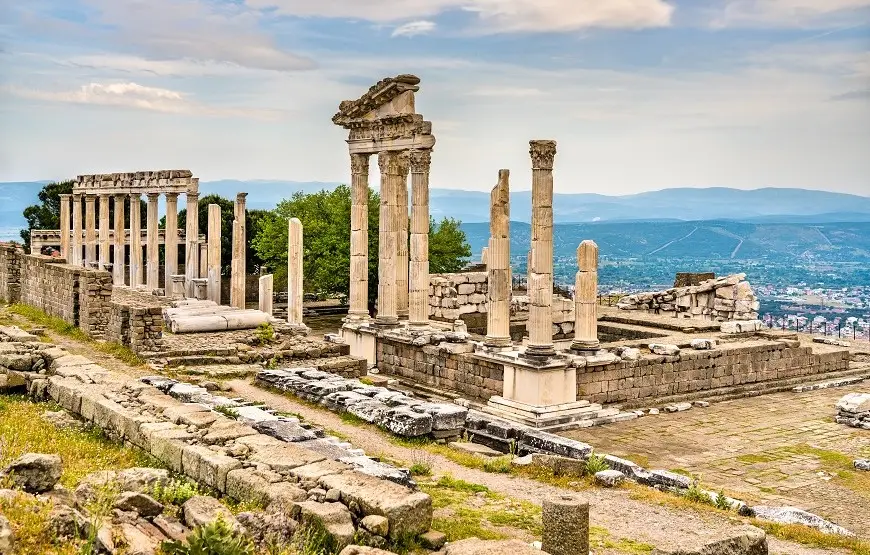
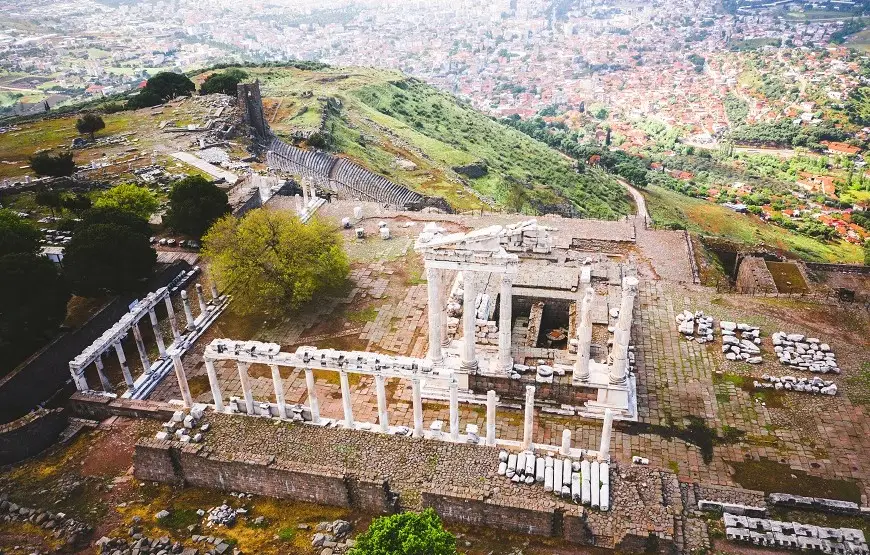
- The Temple of Trajan (Trajaneum). The white marble columns of this Roman temple, partly re-erected, crown the highest terrace and are the image most people associate with Pergamon. It was dedicated to the emperor Trajan and completed under Hadrian.
- The Library. Pergamon's library was one of the largest of antiquity, said to rival the library of Alexandria. Only its foundations remain. Ancient tradition links Pergamon with the development of parchment; the word itself derives from the city's name.
- The Altar of Zeus site. On a terrace below the summit you will see the foundations of the Great Altar, shaded by pine trees. More on the altar itself below.
- The Temple of Athena and the royal palaces. Foundations of the sanctuary of Athena, the city's patron goddess, and of the Attalid palaces.
- Arsenals, cisterns and city walls. Remains of military storehouses and the clever water system that supplied the hilltop.
Allow about two hours on the Acropolis. Paths are uneven and some sections are steep, so wear good shoes.
The Altar of Zeus: why it is in Berlin
The Great Altar of Pergamon, built in the first half of the 2nd century BC and usually attributed to the reign of Eumenes II, was one of the masterpieces of Hellenistic art. Its huge marble frieze shows the battle between the gods and the giants (the Gigantomachy), probably a symbol of the Attalid victories over the Galatians.
In the late 19th century, German excavators under Carl Humann dug out the altar's sculptures and, under the arrangements of the time, transported them to Berlin. There the altar was reconstructed in the Pergamon Museum, built specifically to house it. On the Acropolis you see only its foundations.
The Pergamon Museum in Berlin has been closed for a long-running renovation, and the hall with the altar has been closed even longer. A reopening including the altar is scheduled for 2027; check the museum's official information if you plan to see it. The return of the altar remains a recurring topic in Turkey.
The Asklepion of Pergamon
On the plain at the western edge of Bergama lies the Asklepion, a sanctuary of Asklepios, god of medicine. It was a place where people came from across the Roman world to be healed, combining religion with treatments such as baths, mud, exercise, diet, music and the interpretation of dreams.
The most famous name connected with it is Galen, born in Pergamon in the 2nd century AD, who became the most influential physician of antiquity and later practised in Rome.
What to see at the Asklepion:
- The Sacred Way (Via Tecta). A colonnaded street that led visitors from the city to the sanctuary.
- The courtyard and stoas. A large open square once surrounded by colonnades, with a few re-erected columns.
- The small theatre. A well-preserved Roman theatre for patients and visitors.
- The sacred spring and pools. Water was central to the healing rituals.
- The underground tunnel. A vaulted passage leading to a two-storey round building, thought to have been a treatment centre.
The Asklepion is a short drive from the Acropolis, but it is a separate site with its own entrance. Allow about one to one and a half hours. It lies next to a military area, so follow the signs and do not photograph the military zone.
The Red Basilica (Kızıl Avlu)
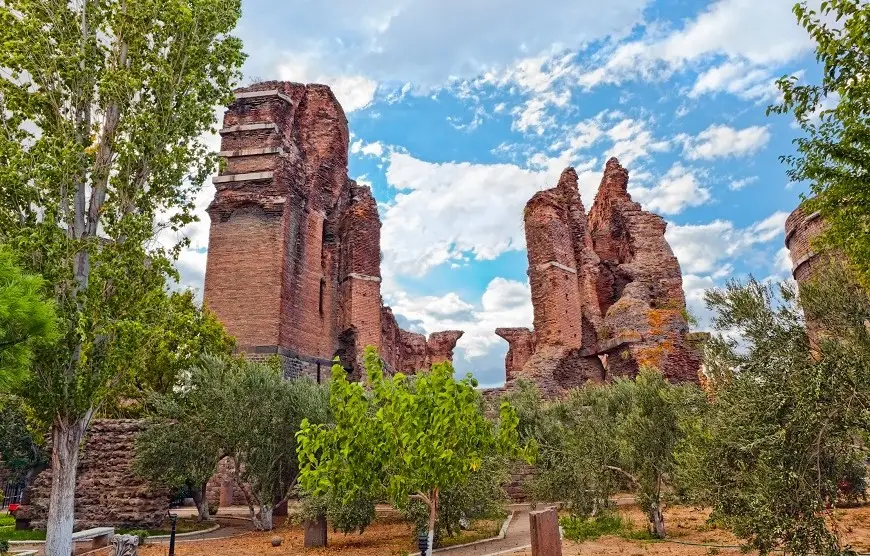
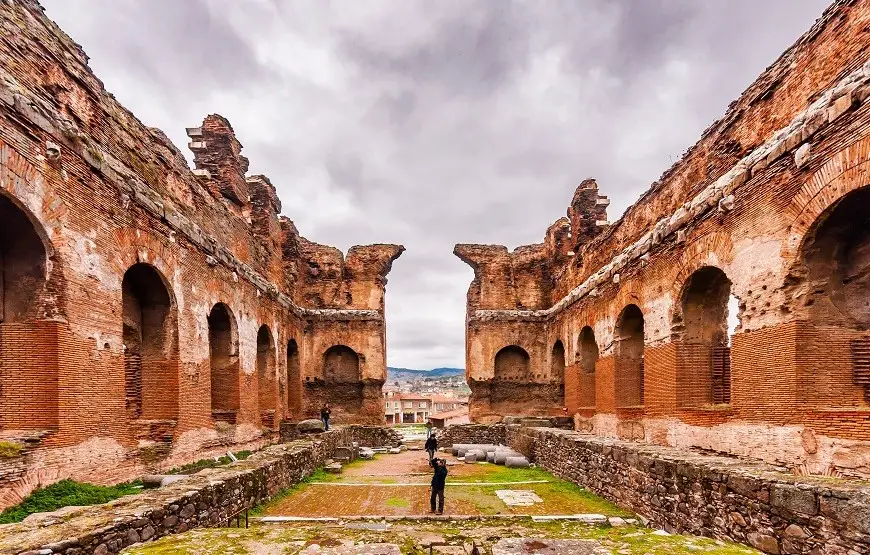
In the centre of Bergama stands the Red Basilica, a massive red-brick building of the Roman period, built in the 2nd century AD as a temple, most likely for Egyptian gods such as Serapis and Isis. The Selinus river flows beneath its huge forecourt through ancient tunnels that still carry water today.
In Byzantine times a church was built inside the main hall, dedicated to St John. Because Pergamon is one of the Seven Churches of Revelation, the Red Basilica is a stop on many Christian heritage routes. Allow 30 to 45 minutes.
Bergama town
The modern town is worth a short stroll. Its old quarter, with Ottoman houses, small mosques and an old bazaar, sits at the foot of the Acropolis. The Bergama Archaeological Museum displays finds from Pergamon and the region. Bergama is also known for its handwoven carpets and for local dishes, including Bergama köfte.
How long to spend at Pergamon
- Acropolis only: about 2 hours plus the cable car.
- Acropolis, Asklepion and Red Basilica: most of a day, which is what we generally recommend.
- Overnight: staying in Bergama or nearby Ayvalık lets you visit the Acropolis in the morning light before the heat.
Summer middays are hot and there is little shade on the summit. Spring (April–May) and autumn (September–October) are ideal. Start with the Acropolis early, then visit the Asklepion and Red Basilica later in the day.
How to get to Pergamon by car
Driving gives you the freedom to see all three sites in one day, since they are spread across and around the town. For road rules and tips, see our guide to driving in Turkey.
- From Izmir: about 1.5 hours north via the coastal motorway and the Bergama turn-off.
- From Ayvalık: about 1 hour southeast.
- From Troy / Çanakkale: about 3 hours south along the coast.
- From Istanbul: a full day's drive; better split with a night near Çanakkale. See our Istanbul to Izmir by car guide.
There is parking at the cable car's lower station, at the top of the Acropolis road, at the Asklepion and near the Red Basilica.
Combining Pergamon with Troy, Ayvalık and Izmir
Pergamon sits in the middle of the classic Aegean road trip from Istanbul to Ephesus:
- Gallipoli and Troy – the Dardanelles, the 1915 battlefields and the legendary city.
- Assos – a temple of Athena above the sea.
- Ayvalık and Cunda island – olive oil, stone houses and seafood, and the Şeytan Sofrası viewpoint at sunset.
- Pergamon – Acropolis, Asklepion and Red Basilica.
- Izmir – a lively seaside city with a historic bazaar and an excellent food scene.
- Ephesus – about an hour south of Izmir, followed by Şirince and the road to Pamukkale.
Seen together, Troy, Pergamon and Ephesus form a remarkable sequence: Bronze Age legend, Hellenistic royal capital and Roman metropolis. Our Turkey road trip itinerary guide shows how to pace them.
Plan it as a self-drive trip
Pergamon is the natural halfway point between the Dardanelles and Ephesus. A comfortable plan is a night in Ayvalık after Troy, a full day at Pergamon, then on to Izmir or Selçuk. Our Istanbul to Izmir, Istanbul–Ephesus–Pamukkale and Istanbul to Fethiye routes include Pergamon, as does the longer Grand Turkey for Summer.
Road Trip Turkey designs each trip for you: we plan the route, book the hotels and rental car, and support you 24/7 while you drive. Tell us your dates and interests and we will send you a personal itinerary. Our self-drive Turkey guide explains how it works.