Most people come to Pamukkale for the brilliant white travertine terraces. Many are surprised to discover that on top of them lies an entire ancient city: Hierapolis, a Greek and Roman spa town with a great theatre, colonnaded streets, temples, churches and one of the largest cemeteries of the ancient world. Of all the ancient cities in Anatolia, few combine history and natural spectacle in the same place so completely.
This guide explains what Hierapolis was, what to see there, how it relates to the Pamukkale travertines, and how to plan your visit so that you see the city and not just the terraces.
What and where is Hierapolis?
Hierapolis is an ancient city in southwestern Turkey, built on the plateau directly above the travertine terraces of Pamukkale, about 20 km north of the city of Denizli. The name means "holy city" in Greek, a reference to its many temples and sacred springs. Today Hierapolis and the Pamukkale travertines form a single site.
Its location explains everything about the city. Hot, mineral-rich springs rise here from deep faults in the earth. The same water that built the white terraces drew people to Hierapolis for healing, bathing and worship for many centuries.
Hierapolis and Pamukkale: one UNESCO site
Hierapolis-Pamukkale was inscribed on the UNESCO World Heritage List in 1988 as a mixed site, recognised both for its natural phenomena (the travertines) and its cultural value (the ancient city). The travertines and the ruins are not separate visits but one landscape. For more on the white terraces themselves, read our guide to the travertines of Pamukkale and our page on Pamukkale.
A short history of Hierapolis
Hierapolis was founded in the 2nd century BC by the Attalid kings of Pergamon, probably under Eumenes II. A local legend links its name to Hiera, the wife of Telephos, the mythical founder of Pergamon, although most scholars connect it to the many sanctuaries of the city.
After the Attalid kingdom passed to Rome in 133 BC, Hierapolis became part of the Roman province of Asia. A severe earthquake in AD 60 destroyed much of the city, and it was rebuilt in grand Roman style. Its golden age came in the 2nd and 3rd centuries AD, when emperors visited and its thermal baths, textiles and dyeing industry made it rich. Wool dyed with the local mineral waters was especially prized.
Hierapolis was also important in early Christianity. According to tradition, the apostle Philip was martyred here in the 1st century AD, and the city became a bishop's seat and a pilgrimage centre. Repeated earthquakes, especially in the 7th century, brought decline, and the city was gradually abandoned. Italian archaeologists have excavated the site since the 1950s and continue to make major discoveries.
What to see in Hierapolis ancient city
Hierapolis is large, stretching for about 2 km along the plateau. The main sights below run roughly from north to south.
The North Necropolis
Whether you enter from the north or walk there, the North Necropolis is one of the most extraordinary sights in Turkey. It is among the largest ancient cemeteries in Anatolia, with hundreds of tombs spread along the road outside the city walls: simple sarcophagi, house-shaped tombs, circular tumuli and grand family monuments, dating from the Hellenistic to the early Christian period.
Many people came to Hierapolis hoping the thermal waters would cure them, and those who did not recover were often buried here, which helps explain the size of the cemetery. Walk along it slowly; the views over the plain and the inscriptions on the tombs are fascinating.
The Frontinus Gate and Frontinus Street
Leaving the necropolis, you reach the Frontinus Gate (also called the Domitian Gate), a monumental triple-arched gateway flanked by two round towers. It was built in the AD 80s and dedicated to the emperor Domitian, and it is one of the best-preserved Roman structures at the site and a perfect photo spot.
Beyond it runs the city's main colonnaded avenue, Frontinus Street, named after Sextus Julius Frontinus, a Roman proconsul of Asia in the 1st century AD. Paved in large limestone blocks, it was lined with shops and porticoes on both sides. Further along, the street passes through the North Byzantine Gate, flanked by two towers, which belonged to the later, smaller city walls of late antiquity.
Near the gate are the remains of a large public latrine, a reminder of the comforts of a Roman city.
The Agora
East of Frontinus Street lay one of the largest agoras (market squares) of the ancient world, surrounded by colonnades. Excavation and restoration are ongoing, and parts of its stoa columns have been re-erected.
The Plutonium (Pluto's Gate)
The Plutonium was a sanctuary built over a cave from which toxic gas, mainly carbon dioxide, rises from deep underground. Ancient writers such as the geographer Strabo described how birds and animals that entered it died, while the eunuch priests of the goddess Cybele could go inside unharmed, apparently by holding their breath or staying above the heavy gas. To the ancients it was an entrance to the underworld, ruled by Pluto (Hades).
Its exact location was rediscovered in 2013 by an Italian team led by Francesco D'Andria, who found the cave, a small temple, steps for spectators and marble statues, including one of Cerberus, the three-headed dog that guards the underworld. The gas is still dangerous, so the sanctuary can only be viewed from outside. It lies close to the Temple of Apollo, the city's main sanctuary.
The Theatre
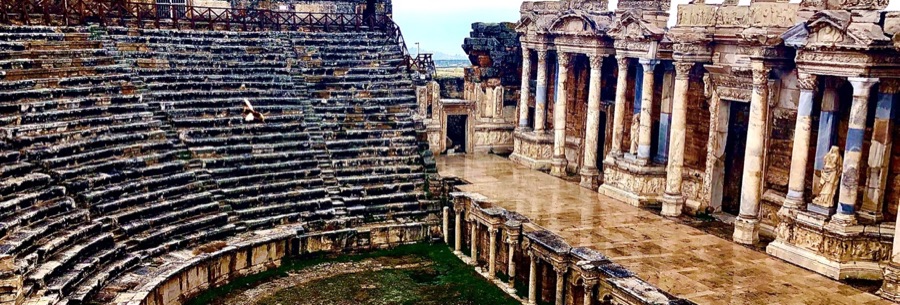
The theatre of Hierapolis, set into the hillside above the city, is one of the finest Roman theatres in Turkey. It was rebuilt after the AD 60 earthquake and took its final form in the early 3rd century AD. It seated well over ten thousand spectators.
The real treasure is the stage building, which has been carefully restored. Its carved reliefs show scenes from mythology, including scenes connected with Dionysus, Apollo and Artemis. From the top rows the view over the ruins and the plain is superb. It is a short but steep walk uphill from the Antique Pool.
The Martyrium of St Philip
Further up the hill to the east, reached by a stepped path, stands the Martyrium of St Philip, an octagonal building of the 5th century AD built to commemorate the martyrdom of the apostle. In 2011 the Italian excavation team announced the discovery of a tomb believed to be Philip's, inside a church a short distance from the Martyrium. The climb takes some effort, but the site is atmospheric and quiet.
The Antique Pool (Cleopatra's Pool)
In the middle of the site lies the Antique Pool, a thermal pool fed by the same warm, mineral-rich spring that has flowed here since antiquity. Its floor is scattered with fallen marble columns and capitals from a portico that collapsed into it during an earthquake, so you literally swim among ancient ruins.
It is popularly called "Cleopatra's Pool", and some stories claim Mark Antony gave it to Cleopatra, but there is no historical evidence for this; the name is a modern legend. The water is warm all year round, close to body temperature. Swimming is arranged separately from the general site visit; you can also simply watch from the café terraces around it.
The Hierapolis Archaeology Museum
The museum is housed in the restored Roman baths next to the travertines. It displays sarcophagi, statues and reliefs from Hierapolis, as well as finds from nearby sites such as Laodicea and Tripolis. The theatre reliefs on display are some of its highlights. Allow 45 minutes.
The Great Baths and the South Gate area
At the southern end of the city, near the travertines, are the Great Baths, the South Byzantine Gate and the remains of a cathedral and churches. From here the city opens onto the top of the white terraces.
How Hierapolis and the Pamukkale travertines are related
The travertines and the city share a single source: hot springs rich in calcium bicarbonate. As the water flows over the edge of the plateau and cools, it releases carbon dioxide and deposits calcium carbonate, which hardens into the white terraces and pools that give Pamukkale ("cotton castle" in Turkish) its name.
The ancients built Hierapolis here precisely because of these waters. They channelled them into baths, fountains and pools, and even used them in industry. Some ancient water channels are still visible, coated in white mineral deposits. Over the centuries the travertines have advanced and partly covered sections of the necropolis and old structures, which is why you see tombs half-buried in white stone along the edge.
Practical tips for visiting Hierapolis
Entrances
There are three ways in:
- The South Gate, near the travertines and the Antique Pool, the closest to the main highlights.
- The North Gate, near the necropolis, on the side of Karahayıt village. Entering here and walking south through the necropolis and Frontinus Street to the travertines is the most rewarding route through the city.
- The travertine footpath from Pamukkale village at the bottom, where you walk up the white terraces barefoot to reach the city.
With a car, a good plan is to drive to the North Gate, walk the full length of the city to the travertines, and if you like, walk down the terraces barefoot to the village.
Walking on the travertines
To protect the deposits, shoes are not allowed on the terraces; you walk barefoot or in socks. Carry a bag for your shoes. The surface can be rough in places and slippery in others, so walk slowly.
Best time to visit
Come early in the morning or in the late afternoon. Midday in summer is very hot, the white surfaces reflect the sun, and tour groups peak around late morning. Sunset over the travertines is spectacular. Spring and autumn are the most comfortable seasons.
How long to spend
- Travertines and the Antique Pool only: 2 to 3 hours.
- Hierapolis properly, including the necropolis, theatre, Plutonium and museum: 4 to 5 hours.
- Ideal: stay one night in Pamukkale village or Karahayıt, so you can visit in the early morning and enjoy the sunset.
What to bring
Sun protection, a hat, water, comfortable shoes for the ruins, a bag for your shoes on the terraces, and a swimsuit and towel if you plan to use the Antique Pool.
Getting to Hierapolis by car
For road rules and tips, read our guide to driving in Turkey.
- From Denizli: about 20–30 minutes.
- From Selçuk / Ephesus: about 3 hours east.
- From Aphrodisias: about 1.5 hours. Many travelers combine the two in one day on the way from Ephesus.
- From Fethiye or the Mediterranean coast: about 3.5 to 4 hours.
Nearby, the ancient city of Laodicea, another of the Seven Churches of Revelation, is only about 10 km away and worth a short stop.
Plan it as a self-drive trip
Hierapolis and Pamukkale are the natural link between the Aegean and the Mediterranean. A classic route runs from Ephesus via Aphrodisias to Pamukkale, with a night beside the travertines, then on to Fethiye, the turquoise coast or Kekova, or inland toward Cappadocia. Our Istanbul–Ephesus–Pamukkale and Istanbul to Fethiye routes include Hierapolis, as does Grand Turkey for Summer.
Road Trip Turkey designs every trip for one traveler: you. We plan the route and timing so you reach Hierapolis at the right hour, book your hotels and rental car, and support you 24/7 on the road. Tell us your dates and wishes and we will send you a personal itinerary. To see how it works, read our self-drive Turkey guide and our Turkey road trip itinerary ideas.